"I can never read all the books I want; I can never be all the people I want and live all the lives I want. I can never train myself in all the skills I want. And why do I want? I want to live and feel all the shades, tones, and variations of mental and physical experience possible in life." ~Sylvia Plath
Showing posts with label books. Show all posts

Wednesday, October 5, 2011

From My Bookshelf

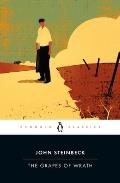
Grapes of Wrath by John Steinbeck

This title has graced my "must read" list since high school.  It took the decision by my book group to finally force me to pick it up and read it from cover to cover, and I was actually surprised to discover how much I enjoyed the story.  I also happened to be in the middle of reading Atlas Shrugged when I picked it up in order to finish it in time for our discussion group.  It turned out to be a nice balance to the sometimes heavy-handed economic philosophy preached by Rand.

Interestingly, the novel was written in only 93 sittings.  In the novel, Steinbeck chronicles the forced exodus of the Joad family from their family farm in Oklahoma to the supposed "promised land" of California.  The entire family (grandparents, children, spouses, siblings, etc.) makes the arduous journey in one car.  Upon arriving in California they find jobs almost impossible to come by, unsanitary living conditions, unlivable wages, and the threat of starvation facing them daily.

Interspersed through the novel are chapters called "interchapters."  These chapters break from the main storyline and paint a picture of a situation/place/issue.  The leader of our discussion explained that the interchapters serve as the Greek chorus.  In Greek plays, the Greek chorus always "offered a variety of background and summary information to help the audience follow the performance."  For example, the first interchapter  takes a look at a used-car lot and the shady business practices of the salesmen.  The dialogue and narrative are blended in a way that is typical of American writing and has (I learned) been compared to jazz.  I found these interchapters to be my favorite part of the book.  They have almost a rhythmic, lyrical quality that I enjoyed (even though the content was depressing).

Steinbeck was uniquely prepared to write this book.  He was a reporter and wrote on the conditions of the labor camps.  He drove along Rt 66 from New York to California and saw the families migrating.  His first-hand experience is apparent and he decidedly succeeds in engaging the reader's emotions and creating a visceral reaction to the trials of these families.  Grapes of Wrath was referred to by FDR, it created a series of Senate inquiries into the conditions of the camps, and spurred Eleanor Roosevelt to actually visit the camps. 

Steinbeck stated that, "I've done my damndest to rip a reader's nerves to rags, I don't want him satisfied ... I tried to write this book the way lives are being lived not the way books are written."  He certainly succeeded.  I was in a constant state of shock at how anyone could survive the conditions that the Joads face in their daily lives and how people could treat their fellow humans with such indignity and malice.

The people come with nets to fish for potatoes in the river, and the guards hold them back; they come in rattling cars to get the dumped oranges, but kerosene is sprayed.  And they stand still and watch the potatoes float by, listen to the screaming pigs being killed in a ditch and covered with quicklime, watch the mountains of oranges slop down to a putrefying ooze; and in the eyes of the people there is the failure, and in the eyes of the hungry there is a growing wrath.  In the souls of the people the grapes of wrath are filling and growing heavy, growing heavy for the vintage.

Thursday, April 7, 2011

From My Bookshelf

Player Piano by Vonnegut

I hated Slaughterhouse-Five when I read it in high school.  I'm sure I didn't get most of it, and I would never have picked up another Vonnegut book were it not for the recommendation of a fellow trusted bibliophile.  So, I began reading Player Piano only to find that I couldn't put it down.  
The main character, Doctor Paul Proteus, exists in a dystopian society where computers and machines do everything.  The average citizen has been stripped of the ability to work at a vocation.  Forced to do mundane, pointless jobs, they are supposedly living in a "perfect" world; everything is planned by computers, taking away choice, creativity, hope, etc.

The main storyline is interspersed with vignettes of the visit by the Shah of Brapuhr.  He is in the US to learn from the richest, most powerful nation how to improve his country.  The scenes where he keeps referring to the average citizen as a takaru (much to the annoyance of his guide) are hilarious.  Takaru means "slave" in the Shah's language.  As an unbiased observer, he is able to see that the citizens lead a life equivalent to that of a slave.  He is completely nonjudgmental and matter-of-fact when he uses the term.  He just believes these people must be the slaves since their lives mirrors the slaves in his country.  He sees right through all the gilding to the reality of the society. 
 
My favorite character is Ed Finnerty.  He is Proteus' best friend and possesses a "devil may care" attitude which I love.  Finnerty does not play along with the perfect world - he is jaded and disillusioned.  Since he won't play the part, he comes across as being a bit crazy, but I think he is just trying to keep it together trying to exist in an insane world.  He knows life is more than this.  It is Finnerty gets Paul thinking about the ills of their supposed utopian society and connects him with the "terrorist" group - the Ghost Shirt Society. 
"Without regard for the wishes of men, any machines or techniques or forms of organization that can economically replace men do replace men. Replacement is not necessarily bad, but to do it without regard for the wishes of men is lawlessness"

Wednesday, March 2, 2011

18 Miles of Books

18 Miles of BooksThis past weekend, I was in NYC visiting my sister, brother, and sister-in-law.  We had some time to kill before our dinner plans, so we stopped at one of my favorite book stores ever ...  Strand Book Store

Yes, no need to pinch yourself, it's true ... 18 miles of books.  Barnes and Noble and Borders cannot compete.  Not only is the sheer quantity of books amazing, but the organization and displays are equally impressive.  The shelves are all made of true wood (not laminate or compressed whatever made to look like wood) and there are wooden "tables" displaying books throughout the main aisles.  One of my favorite parts about the store are the random ladders throughout the aisles for anyone (not just store employees) to use.  I LOVE that!  I didn't take any pictures in the store, but I found one on flickr so you can see a ladder in the aisle.

Those close to me are fully aware of my recent love affair with Rainer Maria Rilke.  If you follow me on Facebook, you've probably also noticed that I tend to post a lot of quotes by him.  I hunt down the poetry section in every book store which I step foot to see if they sell any Rilke.  Usually they do, happily.  Not so happily, the books are always quite expensive, so even though I love his poetry, I did not yet own anything by him.  That all changed this weekend.  Thanks to Strand's amazing prices, I purchased a book by Rilke with a publisher price of $14.00 for less than $8.00 after taxes.

I will leave you with Sonnet 7 from his collection Sonnets to Orpheus, the second series.  They're all amazing, so I just picked one.

I wish I could speak with such beauty about flowers being cut and arranged :)


Flowers, ultimately sisters of arranging hands
(those hands of girls from now and then)
who often lay from end to end across the garden
table, drooping and gently wounded,

waiting for water that would rescue you.
once more from that beginning death, and now held
up again between the streaming poles
of sympathetic fingers that can do

even more good than you guessed, light ones,
when you found each other again in the vase,
cooling slowly, exuding warmth of girls like confessions

from yourselves, like dreary and exhausting
sins committed by your being plucked, but as
a bond again with them, your allies in blooming.

Photo used under Creative Commons license from http://www.flickr.com/photos/16151021@N00/4400554590/.
Related Posts Plugin for WordPress, Blogger...